Under federal law, tip pooling rules come down to two questions: does the employer take a tip credit, and who is in the pool. If you pay tipped staff less than the full minimum wage and count their tips toward the rest, the pool can include only employees who customarily receive tips. If you pay everyone the full minimum wage in cash, the pool can also include cooks and dishwashers. In every case, owners, managers and supervisors cannot take a share.
That is the short version. The detail sits in guidance from the US Department of Labor’s Wage and Hour Division, mainly Fact Sheet 15 on tipped employees and the companion material on tip ownership and managers. It matters because a well-meant policy can still break the law.
Here is what the federal Fair Labor Standards Act allows, where state law can tighten it, and what to check before you rewrite your own tip-out sheet.
Key takeaways
- Employers, managers and supervisors can never keep employees’ tips, directly or through a pool.
- If you take a tip credit, the pool is limited to customarily tipped roles such as servers, bussers, counter staff and service bartenders.
- If you pay the full federal minimum wage with no tip credit, cooks and dishwashers can be included in a mandatory pool.
- Managers may pay into a mandatory pool but cannot take from it.
- Several states ban the tip credit outright, and state pooling rules can be stricter than federal law.
In this guide
- Who counts as a tipped employee
- The one rule that never bends
- Tip credit pools vs full-wage pools
- Where back-of-house staff fit
- State rules can be stricter
- FAQ
- Before you change your tip policy
Who counts as a tipped employee
The FLSA defines a tipped employee as someone in an occupation where they customarily and regularly receive more than $30 a month in tips, according to the Labor Department’s Fact Sheet 15. Only tips the employee actually receives count toward that threshold.
Tipped status does nothing on its own. It simply makes the employer eligible to use the tip credit, which is where most pooling questions start.
How the tip credit works
Under federal rules an employer can pay a tipped employee a direct cash wage of at least $2.13 an hour and count tips toward the rest of the $7.25 federal minimum. That makes the maximum federal tip credit $5.12 an hour. If cash wage plus tips falls short of $7.25 in a workweek, the employer has to make up the difference.
The credit also comes with a notice requirement. Before claiming it, the employer must tell tipped staff the cash wage, the amount of tip credit claimed, that the credit can’t exceed tips actually received, that employees keep their tips except under a valid pool, and that the credit doesn’t apply without this notice. The notice can be oral or written, but without it there is no tip credit.

The one rule that never bends
The core rule is blunt. Fact Sheet 15 states that the FLSA prohibits employers from keeping any portion of employees’ tips, including through managers and supervisors. The Department’s tip regulations page ties this to 2018 amendments to the FLSA, which expressly barred employers, managers and supervisors from keeping tips, and notes that the Department restored its ability to assess civil money penalties against employers who take tips.
A tip belongs to the people who earned it. The owner’s job is to distribute it fairly, never to share in it.
Who counts as a manager
The Department uses a three-part duties test, set out in Fact Sheet 15B. A person is a manager or supervisor for tip purposes if they:
- have a primary duty of managing the business or a recognised department or subdivision of it;
- customarily and regularly direct the work of at least two full-time employees or their equivalent; and
- have authority to hire or fire, or their recommendations on hiring, firing, promotion or other status changes carry particular weight.
Job title does not decide it. A “shift lead” who meets all three tests is a manager for these rules, and a “floor manager” who meets none of them may not be.
The narrow exception
A manager may keep tips received directly from a customer for service they directly and solely provided. Fact Sheet 15B gives the example of a restaurant manager who tends bar for a shift: tips handed straight to them for that bartending are theirs, but they cannot draw from the mandatory pool. A manager who helps run food alongside servers cannot claim part of a shared tip, because that service wasn’t solely theirs.
Managers are not prohibited from contributing to a mandatory pool. They just cannot receive from it.
Tip credit pools vs full-wage pools
The biggest structural decision is whether the business takes a tip credit. It changes who can legally share in the pool.
| Employer takes a tip credit | Employer pays full minimum wage, no tip credit | |
|---|---|---|
| Direct cash wage | At least $2.13 an hour (federal) | At least $7.25 an hour (federal) |
| Who can be in a mandatory pool | Only customarily tipped roles: servers, bussers, counter staff who serve customers, service bartenders | Tipped staff plus non-tipped staff such as cooks and dishwashers |
| Managers and supervisors | May not receive from the pool | May not receive from the pool |
| Employer or owner share | Never | Never |
| Notice to staff required | Yes, before claiming the credit | No tip credit notice, but tips still belong to employees |
Fact Sheet 15 frames the two sides clearly. An employer taking a tip credit can require contributions only to a pool limited to employees in occupations that customarily and regularly receive tips. An employer paying the full $7.25 in direct wages may impose a mandatory pool that includes employees outside those occupations.
Card fees and service charges
Two related rules often come up during a pooling review. Where a card company charges a fee on a tip, the employer may reduce the tip paid to the employee by that fee, but by no more than the actual transaction fee, the deduction can’t push wages below minimum wage, and the tip must be paid no later than the regular payday.
A compulsory service charge, such as a fixed percentage added to the bill, is not a tip under the FLSA. It is business revenue, which the employer can use toward wage obligations, and it sits outside the tip pooling rules altogether.
Where back-of-house staff fit
Including the kitchen is the reason many operators look at tip pooling in the first place. Line cooks and dishwashers work as hard as anyone on a Saturday, and a server-only pool can create real friction.
Federally, the route is open only if the business gives up the tip credit and pays those tipped employees the full minimum wage in direct cash. Once it does, cooks and dishwashers can share in a mandatory pool. Keep taking the credit, and they have to stay out.
Questions to settle before you include the kitchen
- Is the tip credit worth keeping? Compare the wage savings against the retention benefit of a wider pool.
- How will shares be calculated? Points by role, hours worked or a mix. Write the formula down and apply it consistently.
- Who administers it? Someone has to run the numbers each pay period, and it can’t be a manager who also draws from the pool.
- What does state law say? A pool that is legal federally may still fail a stricter state rule.
Pay structure has knock-on effects for menu pricing and labor cost, so it’s worth reading alongside our guide to managing restaurant labor costs.
State rules can be stricter
Federal law sets the floor, and many states build on it. The Labor Department’s state table of tipped minimum wages, current as of July 1, 2026, lists Alaska, California, Minnesota, Montana, Nevada, Oregon and Washington, along with Guam, as places that require the full state minimum wage before tips. In those jurisdictions there is no tip credit to take.
States can also regulate the pool itself. The same table quotes New Jersey’s rule that all tips must be retained by the employee except under a valid tip pool arrangement limited to tipped employees. Check your state labor department’s guidance before you finalise a policy, because a pool that passes the federal test can still fail a state one.
FAQ
Can the owner take part of the tip pool?
No. The FLSA bars employers from keeping any portion of employees’ tips, whether directly or through a pool, and that includes managers and supervisors.
Can a manager who works the floor share in tips?
They can keep tips a customer gives them directly for service they alone provided. They cannot receive money from a mandatory tip pool, though they may contribute to one.
Can cooks and dishwashers be included in a tip pool?
Under federal law, yes, if the employer pays all tipped employees the full minimum wage and takes no tip credit. If a tip credit is taken, the pool is limited to customarily tipped roles.
Is an automatic gratuity part of the pool?
A compulsory service charge is not a tip under the FLSA. It is revenue the employer can use for wages, so the tip pooling rules don’t govern it, although state law may add disclosure requirements.
Before you change your tip policy
Pull out your current tip policy and test it against three questions: are you taking a tip credit, does anyone in the pool meet the manager duties test, and does your state ban the credit or restrict pools. If any answer is unclear, a short consultation with an employment lawyer costs far less than back wages. For more on the regulations shaping the business, browse our industry news coverage, read up on restaurant payroll basics, or see how other operators run their floors through our restaurant directory.
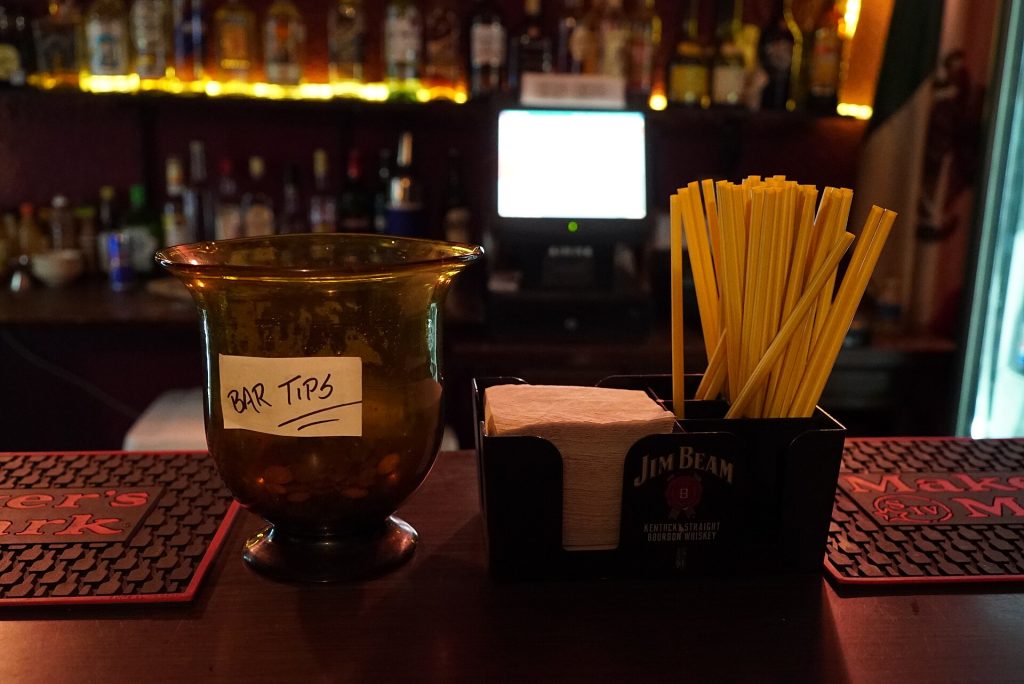
Featured photo: Jarra de propina junto a servilletero en el American Legion by Isa8a, BY-SA 4.0.