Restaurant service fee laws now differ sharply depending on where you operate. California lets restaurants keep a mandatory fee off the menu price as long as it is clearly and conspicuously disclosed wherever prices appear. Minnesota requires mandatory fees to be built into the advertised price. Colorado, since January 1, 2026, asks restaurants to disclose the amount of any mandatory service charge and how it is distributed. The federal FTC fee rule, despite the headlines, does not cover restaurant menus at all.
That patchwork matters for multi-state groups, for anyone writing a new menu, and for guests trying to work out why a 3% or 20% line keeps showing up on the bill.
Below is each regime in plain terms, then a comparison table with effective dates, and a short checklist for getting your menus right.
Key takeaways
- The FTC’s Rule on Unfair or Deceptive Fees took effect May 12, 2025, but it covers only live-event tickets and short-term lodging, not restaurants.
- California’s SB 478 took effect July 1, 2024; SB 1524 lets restaurants, bars and food vendors list a mandatory fee separately if it is clearly and conspicuously displayed wherever prices are shown.
- Minnesota’s price transparency law, in force since January 1, 2025, says a mandatory fee must be included in the total advertised price.
- Colorado’s HB25-1090 took effect January 1, 2026; restaurants can comply by disclosing the percentage or amount of a mandatory service charge and how it is distributed.
- New York City regulates what delivery apps charge restaurants, with caps set as a percentage of each online order.
In this guide
- The federal picture: what the FTC fee rule covers
- California: SB 478 and the SB 1524 restaurant carve-out
- Minnesota: the fee goes inside the price
- Colorado: show the charge and say where it goes
- New York City: the rules sit on the delivery apps
- Restaurant service fee laws side by side
- FAQ
- Audit your menu before the next reprint
The federal picture: what the FTC fee rule covers
Start with the rule most people assume applies everywhere. The FTC’s Rule on Unfair or Deceptive Fees, 16 C.F.R. Part 464, took effect on May 12, 2025. According to the FTC’s own FAQ on the rule, it covers any business that offers, displays or advertises live-event tickets or short-term lodging, including third-party platforms, resellers and travel agents.
That is the whole scope. Restaurant menus, bar tabs and catering quotes are not among the covered sectors, so the federal rule does not tell a restaurant how to present a service charge. The FTC’s general authority over deceptive practices still exists, but the specific all-in pricing rule is limited to tickets and lodging.
Why that matters
With no federal restaurant rule, the real obligations come from states and cities. An operator in one state can be fully compliant while a sister location across a state line is not, even with an identical menu and an identical fee.
California: SB 478 and the SB 1524 restaurant carve-out
California moved first and moved furthest. SB 478, the state’s hidden fees law, took effect on July 1, 2024. The California Attorney General’s guidance says businesses must advertise the full price a consumer will pay, including all mandatory fees, except government taxes and reasonable shipping costs.
Restaurants pushed back, arguing that a blanket rule would force them to fold every fee into every menu price. The legislature responded with SB 1524, signed on June 29, 2024 as an urgency measure, just before SB 478 took effect.
What the carve-out allows
Under SB 1524, restaurants, bars and food vendors may leave a mandatory fee out of the listed price if the fee is clearly and conspicuously displayed wherever prices are shown. In practice that means the menu, the menu board, the website, the ordering app and any advertisement that quotes a price.
- Placement: the disclosure goes on any advertisement, menu or display that carries a food or drink price, not only on the receipt.
- Explanation: the California Restaurant Association’s summary of the bill says the disclosure should explain what the fee is for.
- Visibility: from July 1, 2025, the display rules call for larger type, a contrasting font or color, or symbols that set the language apart from surrounding text.
The carve-out is narrow in one important way: it covers how a restaurant presents its own fee. It does not turn a hidden fee into a legal one. A surcharge that first appears on the check, with nothing on the menu, is the practice both laws were written to stop.
California did not ban restaurant fees. It banned surprising people with them.
Minnesota: the fee goes inside the price
Minnesota took the opposite approach. Its price transparency law took effect on January 1, 2025, and the Minnesota Attorney General’s FAQ is blunt about mandatory charges: a mandatory fee must be included in the total price advertised, displayed or offered.
For a restaurant, that means a separate “wellness fee” or “kitchen fee” can’t simply sit in small print under the menu. If every guest must pay it, it belongs in the price of the dish. The Attorney General’s examples show menus that build the fee into the listed price and add a note that part of the price helps pay for employee health insurance.
Gratuities and delivery
- Gratuities are treated differently. The FAQ separates a true gratuity from a mandatory service fee, and asks that any such charge be disclosed clearly and conspicuously.
- Third-party delivery platforms have their own disclosure duty: they must clearly show any flat fee or percentage charged for delivery.
- Your own delivery service is not a delivery platform under the law, so the AG says delivery costs belong in the advertised price.
For Minnesota operators who used a flat percentage fee before 2025, the simplest route is to raise menu prices to absorb it and explain the change on the menu. Any other structure depends on how the money is actually paid out, which is a question for your lawyer and payroll adviser as much as your menu designer.
Colorado: show the charge and say where it goes
Colorado sits between the two. HB25-1090, the state’s deceptive pricing law, took effect on January 1, 2026. It requires businesses to disclose the total price a person may pay, excluding government charges and shipping, and it gives food and beverage establishments a specific compliance route.
According to the Colorado General Assembly’s bill summary, a restaurant can comply by including, with the price in every offer, display or advertisement, a clear and conspicuous disclosure of the percentage or amount of any mandatory service charge, and how that charge is distributed. Violations are handled under the Colorado Consumer Protection Act.
The distribution line is the new part
California asks what the fee is for. Colorado asks where the money goes. A line such as “A 4% service charge is added to all checks and is shared among kitchen and front-of-house staff” answers both questions, and it makes the fee harder to mistake for a tip. If the charge is split between staff and the business, say so.
New York City: the rules sit on the delivery apps
New York City’s most distinctive rules point at a different fee entirely: the one delivery apps charge restaurants. The city’s Department of Consumer and Worker Protection caps what third-party delivery services may charge restaurants, each as a percentage of the purchase price of an online order, with limited exceptions:
- Delivery fee: capped at 15%.
- Basic service fee: capped at 5%.
- Enhanced service fee: capped at 20%.
- Transaction fee: capped at 3%.
Those caps protect the restaurant’s margin rather than the diner’s bill, but they change the maths behind any in-house surcharge on delivery orders. If you run delivery through apps in the city, check that your invoices match these caps. For more on how the platforms price their services, see our coverage of delivery app fees.
Restaurant service fee laws side by side
Here is how the main regimes line up. Local ordinances can add further requirements, so treat this as the starting point, not the last word.
| Jurisdiction | Rule | In force | What it means for a restaurant fee |
|---|---|---|---|
| United States (federal) | FTC Rule on Unfair or Deceptive Fees, 16 C.F.R. Part 464 | May 12, 2025 | Not covered; the rule applies to live-event tickets and short-term lodging only |
| California | SB 478 hidden fees law | July 1, 2024 | All-in pricing for most businesses, except taxes and reasonable shipping |
| California | SB 1524 restaurant carve-out | Signed June 29, 2024; display rules from July 1, 2025 | Fee may be listed separately if clearly and conspicuously shown wherever prices appear |
| Minnesota | Price transparency law | January 1, 2025 | Mandatory fees must be included in the advertised price |
| Colorado | HB25-1090 | January 1, 2026 | Disclose the percentage or amount of a mandatory service charge and how it is distributed |
| New York City | DCWP delivery app fee caps | In force | Caps on what delivery apps charge restaurants: 15% delivery, 5% basic, 20% enhanced, 3% transaction |
The pattern is clear enough. Every regime that touches restaurant fees rewards the same thing: telling the guest before they order. Keeping up with changes is part of the job, and our restaurant regulation updates track new rules as they land.
FAQ
Does the FTC junk fee rule apply to restaurants?
No. The FTC’s rule, in effect since May 12, 2025, covers live-event tickets and short-term lodging only.
Can California restaurants still charge a service fee?
Yes. Under SB 1524, a restaurant may list a mandatory fee separately if it is clearly and conspicuously displayed on menus and anywhere else prices are shown.
Are mandatory service fees allowed in Minnesota?
A restaurant can still collect the money, but the Attorney General’s guidance says a mandatory fee must be included in the total advertised price rather than added on top.
What does Colorado require on a menu?
From January 1, 2026, the percentage or amount of any mandatory service charge, and how it is distributed, disclosed clearly and conspicuously with the price.
Audit your menu before the next reprint
Pull every place a guest sees a price: printed menus, table tents, menu boards, your website, your own ordering app and each delivery platform listing. For each location, write down the state rule that applies, then check three things: is the fee visible before ordering, does it say what the fee is for, and, in Colorado, does it say how the money is distributed. Fix the gaps before your next menu print run, and ask your lawyer to review any fee that is labeled as supporting staff. For more regulatory updates, follow our industry news coverage, or see how other operators present their menus through our restaurant directory.
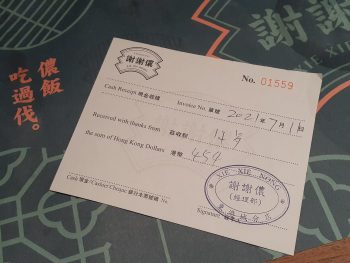
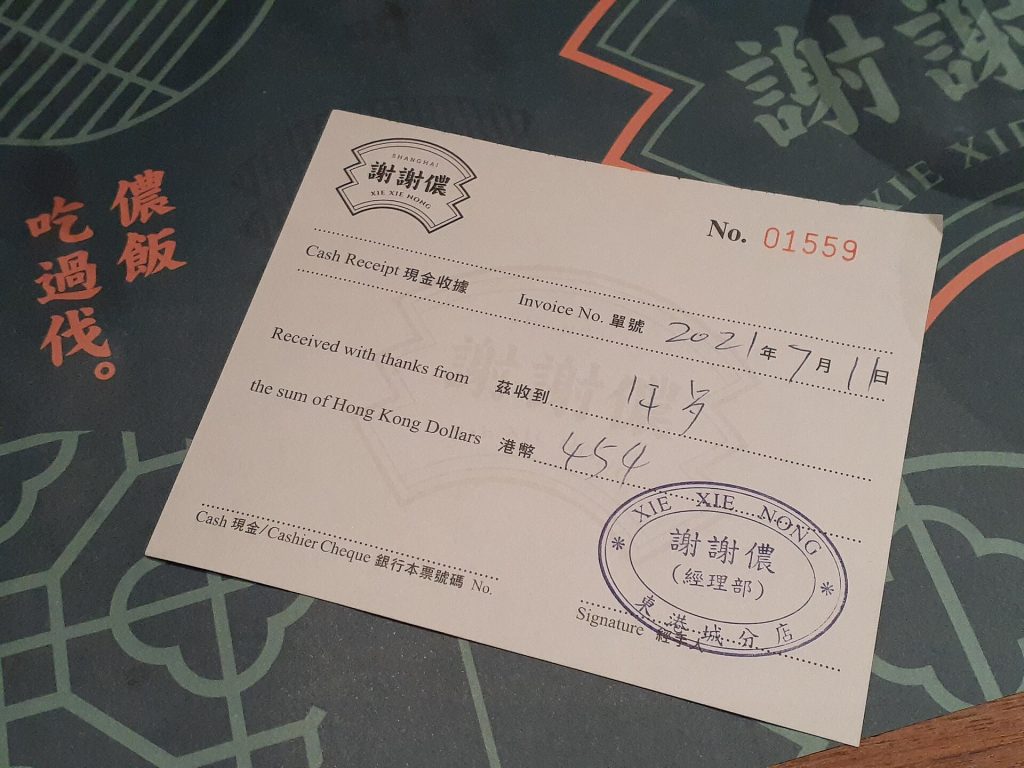
Featured photo: HK SKD TKO 將軍澳 Tseung Kwan O 坑口 Hang Hau 東港城 East Point City mall shop 上海 謝謝儂餐廳 Shanghai Xie Xie Nogn Restaurant bill receipt July 2021 SS2 by Hiqwm Wreop Uis, BY-SA 4.0.