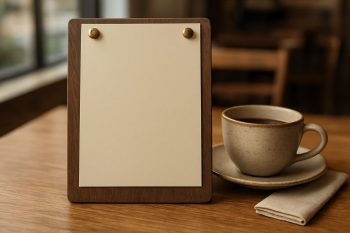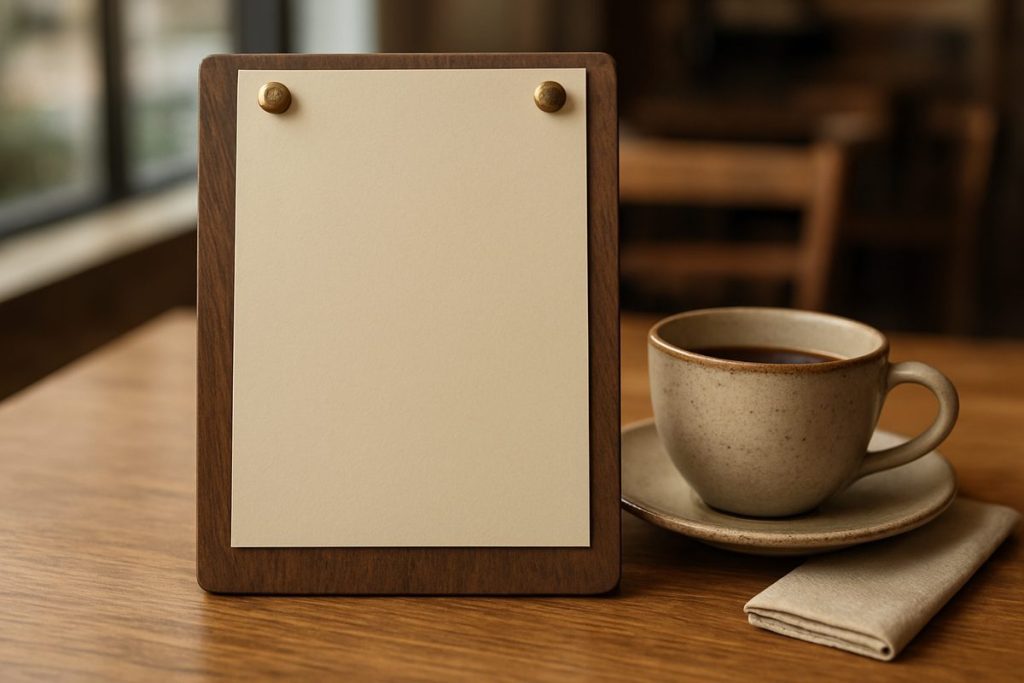
Handheld menu boards are the rigid wooden or acrylic boards that a guest picks up from the table, holds in one hand, and reads like a small clipboard. This is not about wall-mounted chalkboards or digital screens. In a cafe, brunch spot, bar or bistro, the handheld format has a very specific job: it holds a short, changeable menu in a way that feels better than a laminated sheet and is easier to update than a heavy multi-page cover. When you compare menu boards for restaurant use, the handheld version tends to feel more deliberate and easier to refresh.
For operators, the question is not whether a board looks nice. The question is whether it saves staff time, survives a busy service and fits the paper you already print. Most menu board decisions go wrong when a manager buys for the dining room photo instead of the Thursday night rush.
When a handheld board beats a menu cover
Use a board when the menu is short and the changes are regular. A five-item brunch list, a page of wine by the glass, six rotating cocktails or a daily special card all read well on a single rigid board. The guest gets a clean surface instead of a curled sheet of paper, and the kitchen does not have to wait for a full menu reprint.
Long a la carte menus are the wrong fit. Once you get past two or three sheets, a bound menu cover with pockets becomes easier to handle and better at protecting pages. The handheld board is a precision tool for the front page, the special, the patio lunch list and the bar’s current pours.
Patios and counters change the calculation further. Wind will not fold a board the way it folds paper, and a guest at an outdoor table can hold the board steady with one hand while ordering. At a counter or host stand, a stack of boards takes less space than a pile of covers and can be wiped down between turns.
Materials and what they mean during service
Birch plywood with a lacquer finish is the workhorse. It is light, stable in humidity and available in natural, black, white or walnut-stained tones. The edges stay smooth through hundreds of handoffs because the lacquer seals the grain. Solid ash and walnut veneer cost more and show more warmth, but they need more attention at closing because a gouge or a deep scratch is harder to hide than on a painted or stained ply surface.
Clear acrylic boards are the fast option for a modern bar or a bakery case. They tolerate moisture better than wood and can be wiped with a simple cloth. The tradeoff is weight and fingerprints. Acrylic shows smudges on a sunny patio, and a guest will notice if the edge is rough or if a corner chip catches a thumb.
Leather details such as a loop or a strap are not decoration. They give staff a way to hang boards on a wall hook, carry several at once or pull a board out of a stack without pinching the paper. Whatever material you choose, check the weight in a guest’s hand and the edge finish under your own thumb.
Fastening options and how fast pages can be swapped
Two screw posts, sometimes called Chicago screws, are the most reliable choice for one to five sheets. Each post has a threaded barrel and a cap. A server can undo two caps, lift off the old page and put on a new one in under a minute. The pages lie flat and do not slide around when a guest tilts the board. Across a week of changing specials, the screw post version often wins because the motion is simple and the parts are hard to lose.
Metal rings work better when you need to flip pages like a small notebook. They are quick but allow more movement, and a dropped board can tear the punched holes. Elastic bands are the cheapest and fastest for a single sheet, but they stretch, snap and leave a line across the paper. A leather strap or plank holds one or two sheets flat and looks sharp, yet it is slower to swap when the strap is tight.
Whatever you pick, keep extra screws, caps or bands in the manager’s drawer. A missing fastener during dinner service turns a small board into a two-handed problem.
Sizes that match your existing paper
Most kitchens print on standard US letter paper, so an 8.5 by 11 inch board is the default for a full daily menu or a specials page. The half letter size, 5.5 by 8.5 inches, is lighter in the hand and works well for brunch, dessert lists and short wine lists. The narrow 4.25 by 11 inch drinks format suits a single bar list or a wine-by-the-glass card and gives the board a different look on the table.
Do not order a size and then ask the kitchen to cut paper to fit. Match the board to the paper tray first. If your back office uses A4 or A5 because you run European paper sizes, buy boards in those dimensions instead of trimming every sheet. Leave at least a half inch of space above any hole or screw post so the text does not disappear under the cap or the ring.
Also think about how the board sits. An 8.5 by 11 board may be too wide for a crowded cafe table with two plates and two water glasses. A half letter board is easier to pass across a bar or a patio rail. The narrow drink format can be hung on a wall hook or stacked at a host stand without taking much room.
How many boards to order without a fixed ratio
Start with the number of seats you would fill at your busiest turn if every table needed one board at the same time. Then add the bar and patio because those seats often run on separate pages and tend to move faster. After that, add a working set of spares that covers a dropped board, a stretched elastic band, a cracked corner and the boards waiting at the dish area to be wiped.
Do not divide seats by a fixed number and call it done. A counter-service place with a short brunch line may need only a stack near the register plus a few on each table. A full-service spot that changes specials every day and uses boards for the cocktail list, the wine list and the pastry card will need multiple sets in circulation at the same time. The host stand, the back bar and any service station with a printed shift sheet may need their own copies too.
A better method is to walk the floor at the busiest hour and count the points where a guest or a staff member is waiting for a menu. Each of those points is a board you should have in the building. Buy enough for that count, then keep a small reserve for boards that are drying or out of service.
Cleaning, maintenance and the pre-order checklist
Between guests, wipe the board with a damp cloth and a small amount of mild detergent. Dry it with a clean towel right away. Wood should never go through the dishwasher or sit in a sink of water. The heat and moisture will warp the board, lift the lacquer and swell the holes around the fasteners. For clear acrylic, skip alcohol-based cleaners. They can cause fine surface cracks over time, especially at drilled holes and corners.
Before you order, run through this list:
- Menu length and change frequency, so the page count matches the fastener.
- Material and finish, checked for weight, edge feel and moisture resistance.
- Board size matched exactly to the paper already in the printer.
- Fastener type and spare parts kept at a service station.
- Quantity based on the busiest turn, not just the number of tables.
- Cleaning supplies that are safe for the material and quick for staff.
Order a small sample first when you are trying a new material or a new size. Put it on a real table with a real drink and a damp hand. If it feels heavier than a laminated sheet, fine. If it feels awkward or the paper bunches at the fastener, fix that before you buy twenty more.