French table knife etiquette rests on a simple idea: the knife is a working tool that stays in the right hand, cuts only what needs cutting, and is chosen to suit the dish. In a French bistro that means a steak knife arriving with the entrecôte, bread broken by hand rather than sliced at the table, and, in parts of rural France, a guest who still reaches into a pocket for a folding knife of their own. For restaurant owners outside France, those habits say a lot about how a knife shapes the dining experience.
Key takeaways
-
Adults in France spent an average of 2 hours 22 minutes a day eating in 2010, according to INSEE, and the meal is treated as an event, down to the table setting.
-
UNESCO lists “the setting of a beautiful table” among the core elements of the gastronomic meal of the French, inscribed in 2010.
-
The personal folding knife at the table is a rural tradition, tied to work in the fields and to meals eaten away from home.
-
Bistros match the knife to the dish: a plain table knife by default, a dedicated steak knife for red meat, a separate knife for cheese.
-
With US restaurant sales projected at 1.55 trillion dollars in 2026 and margins under pressure, table knives are a small purchase with a visible effect on the guest experience.
Why the French table takes its knives seriously
Meals in France are long and highly synchronized. INSEE, the French national statistics institute, measured an average of 2 hours 22 minutes a day spent eating in 2010, thirteen minutes more than in 1986. The same survey found that at 1 pm, half of adults in France were having lunch. Lunch is still a shared break, not a sandwich at a desk.
That attention extends to the table itself. When UNESCO inscribed the gastronomic meal of the French on its Representative List of the Intangible Cultural Heritage of Humanity in 2010, it named the careful choice of dishes, wine pairing and “the setting of a beautiful table” as key elements, along with a fixed structure of at least four successive courses.
The everyday rules follow from this. The knife sits on the right of the plate, blade turned toward it. It stays in the right hand while the fork stays in the left, with no switching hands after each cut. Bread is broken by hand, not cut. Salad leaves are folded with the fork rather than sliced. Cheese gets its own knife, so the flavors of the main course do not travel to the cheese board.
The folding knife that comes out of the pocket
In rural France, the knife at the table was long a personal object. Farm workers, shepherds and craftsmen carried a folding knife all day for work and used the same blade to cut bread, sausage and cheese at lunch, often eaten outdoors or at a shared farm table. The habit still shows up at village fairs, hunting lunches and country inns, where a regular may open their own knife next to the one the house provides.
Bringing a French folding knife to the table is not a breach of etiquette in that setting. It belongs to a craft tradition that small workshops keep alive, such as one in the Brière marshes of western France that fits its blades with handles of 5,000-year-old bog oak. In a city restaurant the custom is rarer, and the polite move is simple: use the house cutlery unless the setting is informal and the owner clearly does not mind.
For a restaurateur, the lesson is that guests notice knives. A diner who carries a good folding knife will judge the steak knife you lay down against it. A blade that tears the meat or wobbles in the handle is remembered as part of the meal.
Steak knives, cheese knives and the bistro place setting
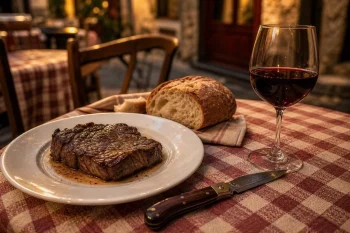
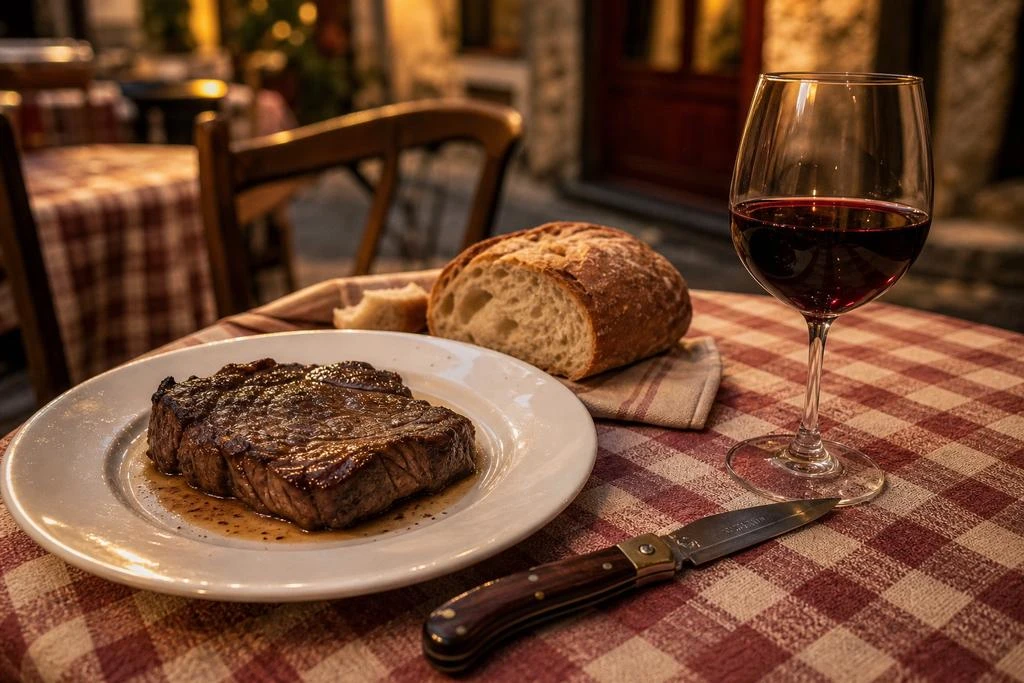
A typical French bistro keeps the setting lean. One table knife and one fork are laid for the starter and main course, and the waiter swaps or adds cutlery as dishes arrive. The steak knife is the clearest example: it comes with the entrecôte or the bavette, not before, which signals the dish and keeps the table uncluttered.
|
Knife |
When it appears |
Edge |
Who provides it |
|---|---|---|---|
|
Table knife |
Laid at the start of the meal |
Rounded tip, light edge |
The restaurant |
|
Steak knife |
Brought with red meat |
Pointed tip, plain or serrated |
The restaurant |
|
Cheese knife |
With the cheese course |
Forked or pierced blade for soft cheese |
The restaurant, often shared |
|
Personal folding knife |
Informal rural meals, picnics, markets |
Pointed, sharpened by its owner |
The guest |
Plain and serrated steak knives behave differently. A serrated edge keeps cutting even when it is dull, which suits a busy kitchen with little time for maintenance, but it saws through meat fibers and leaves a ragged surface. A plain edge cuts cleanly and shows off a well-rested steak, yet it needs regular sharpening. Many bistros that care about their meat choose plain edges and accept the upkeep.
How restaurants choose their table knives
Knives are a small line in a restaurant budget, but they are handled by every guest. The National Restaurant Association projects total US restaurant and foodservice sales of 1.55 trillion dollars in 2026, and reports that 42% of operators said their restaurant was not profitable in 2025. In that context, operators look for purchases that improve the guest experience without raising running costs.
The selection criteria are practical. The knife must survive a commercial dishwasher cycle several times a day, so handle material and how it is fixed to the blade matter more than appearance. Weight and balance affect how the cutlery feels in the hand. Edge type decides how often someone in the kitchen has to sharpen. And stock must cover the dish cycle: a dining room that seats 60 needs well over 60 steak knives in circulation, since part of the set is always in the wash.
A useful test before buying is to cut the house steak with each sample, at the table, with the plate the restaurant actually uses. Some knives that look fine in a catalogue scratch the glaze or skid on a thin cut. Ten minutes of testing avoids replacing a full set a year later.
FAQ
Is it rude to bring your own knife to a restaurant in France?
In rural areas and informal settings it is an accepted tradition, especially among regulars. In city restaurants it is uncommon, so use the cutlery provided unless the setting is relaxed and the staff clearly have no objection.
What are the basic rules of French table knife etiquette?
Keep the knife in your right hand and the fork in your left throughout the meal. Break bread by hand, fold salad leaves with the fork rather than cutting them, and use the separate knife provided for cheese.
Why do French bistros bring a steak knife with the meat?
The steak knife arrives with the dish that needs it, which keeps the place setting simple and signals the course. Its pointed tip and sharper edge cut red meat cleanly, which a standard table knife does not do well.
Sources
-
INSEE, Le temps de l’alimentation en France, Insee Première No. 1417, 12 October 2012: insee.fr/fr/statistiques/1281016
-
UNESCO, Gastronomic meal of the French, Representative List of the Intangible Cultural Heritage of Humanity, inscribed 2010: ich.unesco.org
-
National Restaurant Association, 2026 State of the Restaurant Industry, press release of 12 February 2026: restaurant.org