Every catering order starts with a decision most buyers do not know they are making: drop-off or full service. Get it right and the event runs itself. Get it wrong in one direction and you have paid for staff to watch people serve themselves sandwiches; get it wrong in the other and the CEO is hunting for serving spoons in front of a client. The good news is that the decision follows the event, and the rules are learnable in five minutes.
Drop-off catering means the food arrives prepared, portioned, and ready to serve, usually on disposable platters with everything needed to run the table, and the caterer’s job ends at setup. Full service means staff stay: they set the room, serve or replenish, manage the buffet or pass the trays, and clear afterward. Between them sits a spectrum, delivery with setup, attended stations, partial staffing, but the two poles decide the budget and the feel.
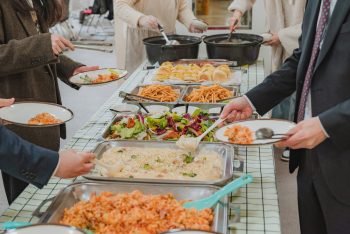
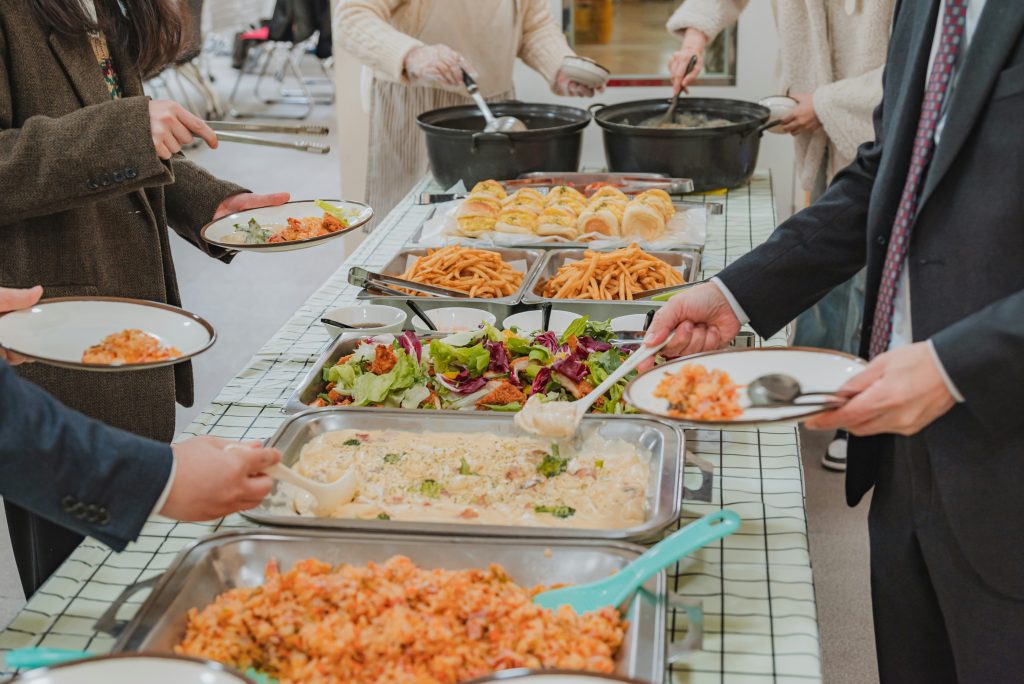
Event size is the first filter, though not the way people assume. Drop-off comfortably handles surprisingly large groups, an all-hands of a hundred grazing a well-planned spread works fine, because self-service scales when the menu is built for it. What breaks drop-off is not headcount but service complexity: courses, hot items that must be replenished in sequence, plated meals, alcohol service, or any moment when the food needs to arrive at people rather than people at the food. A thirty-person seated client dinner needs staff. A hundred-person team lunch does not.
Formality is the second filter. Food service is theater as much as logistics, and staff on the floor tell the room what kind of event it is attending. Board dinners, weddings, retirement sendoffs, and anything with seated guests reads wrong as self-service, at any size. Conversely, staffing a casual sprint-week lunch makes a relaxed event feel oddly supervised. Match the service to the tone you want, not to the budget you fear.
Duration is the third, least obvious filter. Food left out has a safe and appetizing window, and drop-off events should be planned to eat within it. A one-hour lunch is drop-off territory. A four-hour open-house needs replenishment, which means either staggered deliveries or a staffed station. Any caterer who does both formats will tell you honestly which your timeline requires; a caterer who only sells one format will tell you that format fits.
The middle ground deserves a mention, because offices live there. Individually boxed meals are drop-off’s most reliable form for meetings: no line, no shared utensils, every restriction handled at the label. A spread of boxed lunch options covers a working meeting better than any buffet, because the meeting keeps moving while people eat, and the count ordered is the count consumed.
The practical way to decide, in order: fix your timeline and headcount, choose the tone, then ask the caterer which format they would run for that event and why. A kitchen that does both formats daily, from delivered office lunches to fully staffed events, will give a real answer, sometimes the cheaper one, because format mismatches generate the complaints and the repeat business lives in getting it right. That is also the buying tip hidden in this whole subject: choose a caterer whose range spans both formats, so the recommendation you get is about your event rather than their capability.
About the provider: Handheld Catering and Events has run both full-service events and delivered catering across Silicon Valley since 2012 from its Santa Clara kitchen, fully licensed and insured, HACCP certified, and a certified California Green Business. Handheld Catering and Events, 1725 De La Cruz Blvd #1, Santa Clara, CA 95050, (408) 692-4782.