

-
by Restaurants Expert
- August 6, 2026
Buffalo sauce started with the cut nobody wanted. In 1964, butchers dropped chicken wings into stock pots or moved them by the bucket for pennies, because there was almost no meat on them. Then Teressa Bellissimo, working the kitchen at the Anchor Bar in Buffalo, New York, fried a batch and tossed it in melted butter and hot sauce.
The sauce has not changed since. Butter and cayenne heat, whisked hot.
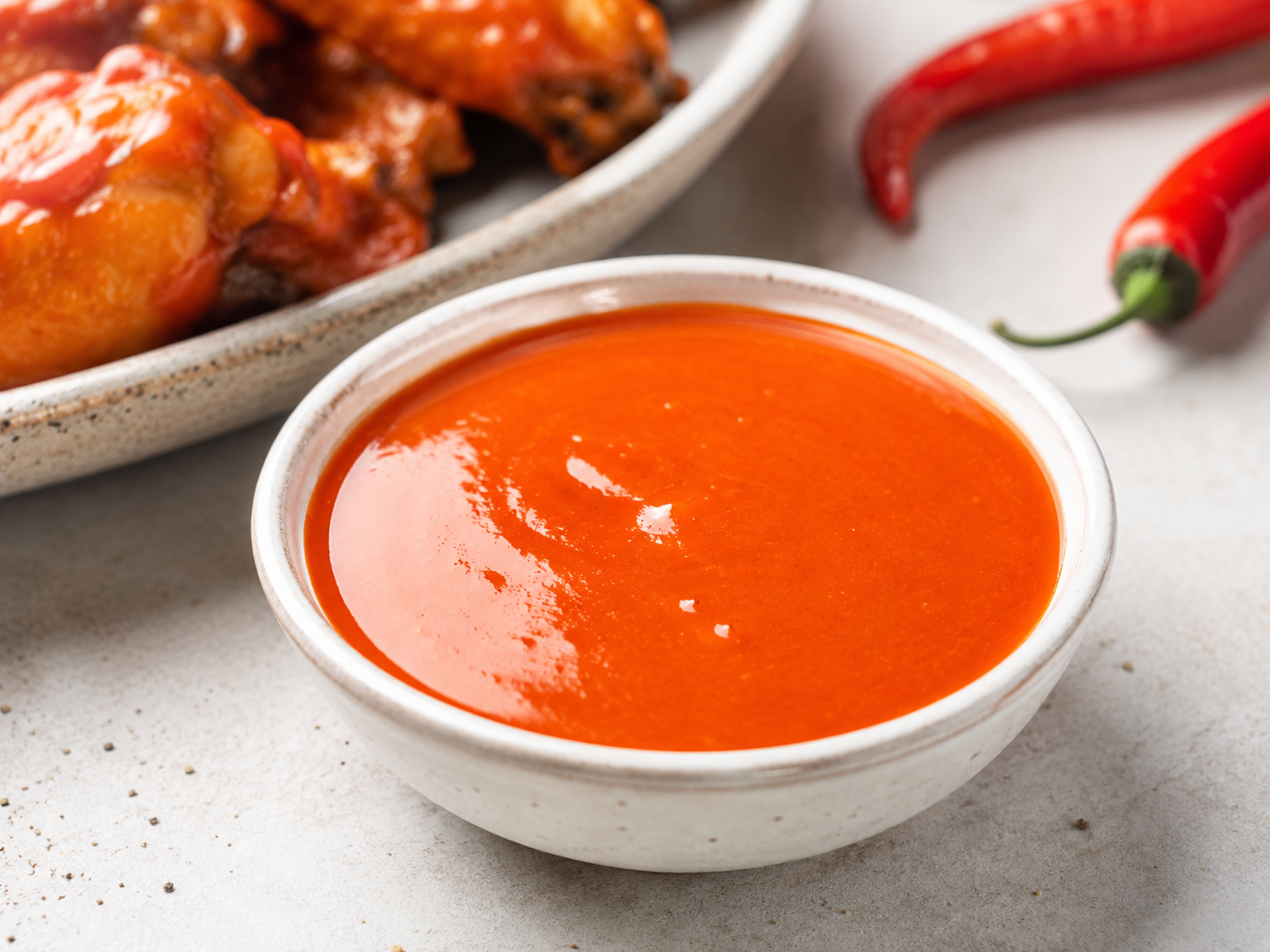
What Is Buffalo Sauce?
Buffalo sauce is an emulsion of cayenne pepper hot sauce and melted butter. The hot sauce brings heat, salt, and vinegar sharpness. The butter brings fat, which rounds off the acid and gives the sauce enough body to cling to whatever it coats.
Most versions add garlic powder for savory depth. Some cooks stir in a sweetener or paprika. Those are refinements, not requirements.
The name refers to Buffalo, New York. It has nothing to do with the animal.
Where Buffalo Sauce Comes From
Buffalo sauce comes from the Anchor Bar in Buffalo, New York, in 1964, where Teressa Bellissimo served the first plate of buffalo chicken wings. Chicken wings at the time were a cheap, largely discarded cut. Frying them and tossing them in butter and hot sauce turned scrap into a bar snack.
Nobody trademarked or standardized the recipe. That is why so many versions exist, and why the ratio logic survived instead of a fixed formula: hot sauce, softened with butter, served with celery and a cooling dairy dip.
Why People Like Buffalo Sauce So Much
Buffalo sauce works because it hits 4 flavor registers in the same bite: spicy, salty, sour, and fatty. Each element keeps the others in check. Heat alone punishes. Vinegar alone turns harsh. Butter alone falls flat. Together they reset the palate between bites, which is exactly why a plate of wings disappears.
The acid does specific work. Buffalo sauce grew up next to deep-fried wings, and its vinegar cuts through the fry oil. That is the mechanism behind eating a dozen of them without quitting.
What Makes Buffalo Sauce Different From Hot Sauce?
Hot sauce is an ingredient. Buffalo sauce is a finished preparation built from that ingredient.
A bottle of cayenne hot sauce runs thin, hits hard, and tastes vinegar-dominant. It gets dashed on in drops. Buffalo sauce takes the same liquid, adds fat, and turns it into something thick enough to coat, mild enough to eat by the spoonful, and rich enough to work as a dip base.
The difference shows on the food. Hot sauce runs off a wing. Buffalo sauce stays on it.
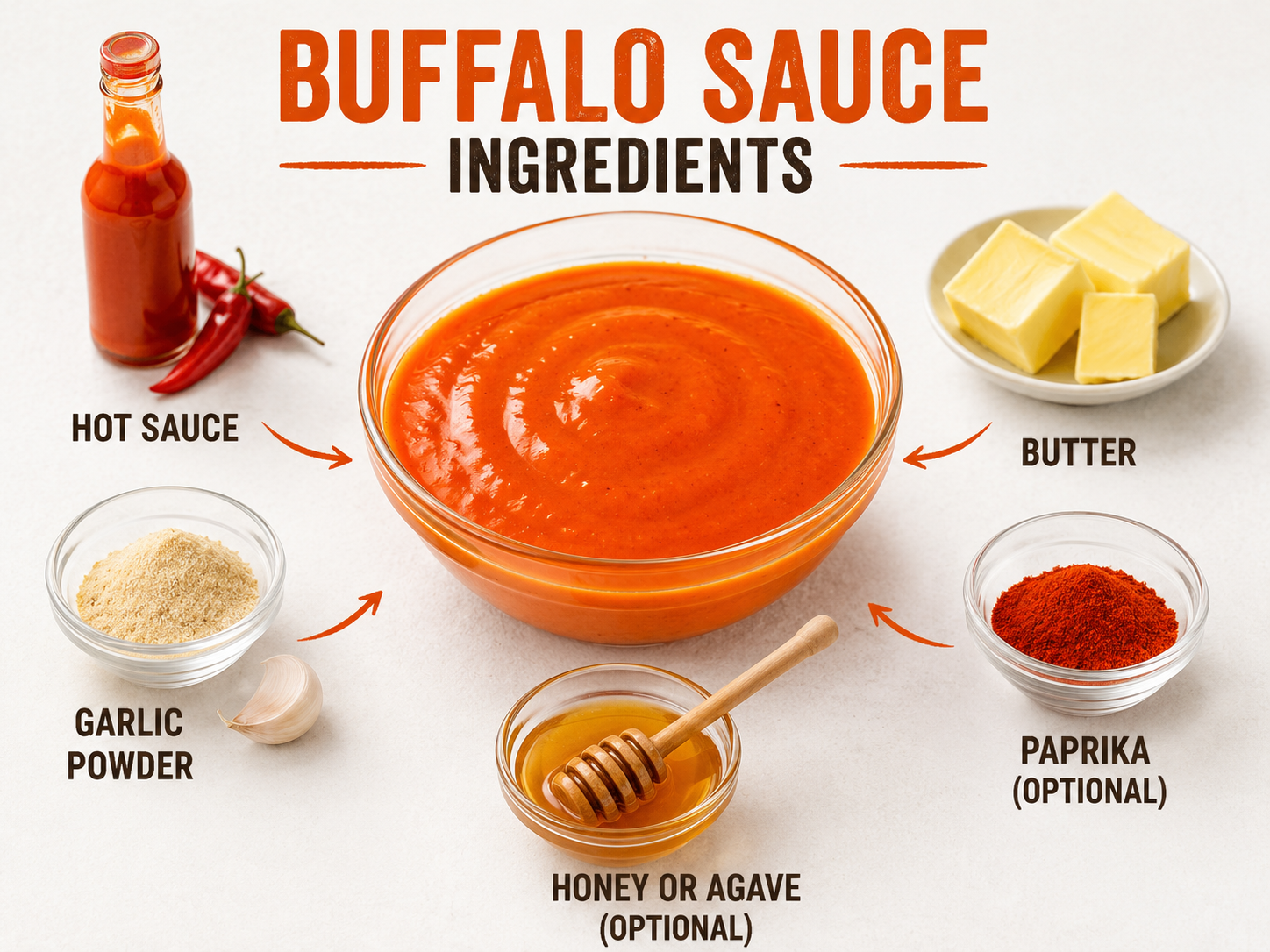
What Ingredients in Buffalo Sauce?
The recipe assigns 1 job to each of its 5 ingredients, and 2 of them are optional.
| Ingredient | Job in the sauce |
|---|---|
| Hot sauce | Supplies heat, salt |
| Butter | Adds fat and body, softens acid and heat, makes the sauce cling |
| Garlic powder | Adds savory depth without adding moisture |
| Paprika (optional) | Contributes earthy color and mild pepper complexity |
| Honey or agave (optional) | Balances sharpness, adds gloss and thickness |
Salted and unsalted butter both work. Salted butter seasons the sauce on its own, so salt-free garlic powder is the safer pairing with it.
You can use these hot sauce for your buffalo sauce
| Brand | Heat (SHU) | Why it works |
|---|---|---|
| Frank’s RedHot Original | 450 | Cayenne, vinegar, water, salt, garlic powder. Emulsifies cleanly. The default. |
| Louisiana Original | 450 | Same heat as Frank’s, no garlic in the bottle. Some cooks find the result oilier. |
| Texas Pete | 747 | Thinner body, close enough to Frank’s to swap 1:1. |
| Crystal | 2,000 to 4,000 | Chili, vinegar, salt only. Hotter than Frank’s, less garlicky, rounder. |
| Tabasco Original | 2,500 to 5,000 | Aggressive vinegar and 5x the heat of Frank’s. Needs extra butter. |
| CHIN-SU Hot Sauce | 1,500 to 2,000 | CHIN-SU’s hot sauce has a naturally thick consistency that helps the sauce cling to chicken wings better than ordinary thin sauces. |
How to Make Buffalo Sauce?
To make buffalo sauce, melt the butter, whisk in the hot sauce and garlic powder, and serve. The method runs 4 steps and 5 minutes.
- Melt 6 tablespoons (85 g) of butter in a saucepan over medium heat, which takes 2 to 3 minutes.
- Add ½ cup (120 ml) of hot sauce and 1 teaspoon of garlic powder to the melted butter, keeping the heat at medium.
- Whisk for 10 to 15 seconds until the mixture combines. A whisk beats a spoon here, because the goal is emulsification, not mixing.
- Use it immediately, or hold it on low-medium heat for 2 to 3 minutes with occasional stirring to serve it warm.
That ratio of 6 tablespoons butter to ½ cup hot sauce yields a mild, butter-forward sauce. Less butter pushes the heat up.
A finished emulsion shows 2 visual cues: no garlic powder clumps in the liquid, and no butter residue on the pan walls. A visible ring of separated fat up the sides means the butter and hot sauce have not come together yet, and more whisking fixes it.
A broken sauce is not a ruined sauce. Gentle reheating and a second round of whisking usually bring it back.
How to Adjust the Heat in Buffalo Sauce?
The butter-to-hot-sauce ratio controls the heat. Adding other peppers does not.
- Milder: raise the butter toward 1:1 butter to hot sauce.
- Hotter: drop the butter toward 1:2 butter to hot sauce.
- Sweeter and thicker: stir in 1 to 2 tablespoons of honey, which also tames the sharp edge.
Cayenne powder raises heat without adding vinegar, so it unbalances the sauce instead of improving it.
How to Use Buffalo Sauce?
Wings are the origin story, and the sauce transfers to at least 7 other formats:
- Wings, bone-in or boneless, tossed immediately after frying or baking
- Buffalo chicken dip, folded in with cream cheese, shredded chicken, and ranch
- Pizza, replacing tomato base under chicken and red onion
- Tacos, drizzled on before the toppings
- Sandwiches, where 1 tablespoon carries the whole build
- Fries, potato wedges, and roasted cauliflower, served as a dip
- Crispy tofu and roasted vegetables, tossed while hot so they absorb it
Celery and a dairy-based dressing show up alongside for a reason. Both blunt capsaicin. Water does not.
How to Store Buffalo Sauce?
Buffalo sauce keeps 7 days in an airtight jar at 40°F (4°C). Pour the finished sauce into the jar, then use it right away or cool it on the counter before refrigerating.
The butter solidifies when chilled, so the sauce firms up and separates in the fridge. Gentle reheating and a quick whisk restore the texture.