For most restaurants the choice between third-party vs in-house delivery comes down to one trade. Apps like DoorDash and Uber Eats bring you customers and drivers, and charge a commission that can run to 30% of the order. Running your own delivery keeps the margin and the customer list, but you take on drivers, insurance and every late order.
Neither is automatically cheaper. The right answer depends on your order volume, your delivery radius, and how much of your delivery business is new customers versus regulars who would order from you anyway.
Below, we compare the two models on the five things that actually move the numbers: commissions, customer data, staffing, insurance and packaging.
Key takeaways
- Published marketplace commissions run from 15% to 30% on delivery orders, depending on the plan you choose.
- Some cities cap delivery commissions; New York City’s permanent cap is 15% on delivery fees and 5% on other fees.
- Apps own most of the customer relationship. In-house delivery gives you names, addresses and order history.
- In-house delivery shifts driver pay, scheduling and auto liability onto you, and personal car policies often exclude business use.
- Many operators run a hybrid: marketplace for discovery, direct ordering for regulars.
Jump to a section:
- The side-by-side comparison
- Commissions and what they really buy
- Customer data and who owns the relationship
- Staffing, drivers and insurance
- Packaging and food quality
- Frequently asked questions
- How to decide for your restaurant
The side-by-side comparison
Here is how the two models stack up on the main operating questions. Commission figures come from the platforms’ own published merchant pricing and can change, so check the current page before you sign.
| Factor | Third-party marketplace | In-house delivery |
|---|---|---|
| Cost per order | Commission, e.g. 15%, 25% or 30% on DoorDash plans; 20%, 25% or 30% on Uber Eats plans | Driver wages or pay per trip, mileage, insurance, ordering software |
| Fixed costs | Low; no monthly fee on the published DoorDash plans | Higher; drivers must be scheduled even on slow nights |
| New customers | Strong: you appear in a large app audience | Weak: you must market it yourself |
| Customer data | Limited; the app owns the account | Full: contact details and order history |
| Delivery experience | Driven by a courier you do not employ | Your staff, your standards |
| Insurance | Couriers are not your staff; confirm coverage terms in your platform agreement | Your responsibility, including non-owned auto exposure |
| Packaging | Your cost; long waits for couriers can hurt food quality | Your cost; shorter, more predictable trips |
| Best fit | New concepts, wide radius, low or unpredictable volume | Dense neighbourhoods, steady volume, loyal regulars |
Commissions and what they really buy
The headline rate is only part of the story. DoorDash’s US merchant page lists Basic, Plus and Premier plans at 15%, 25% and 30% on delivery orders, with 6% on pickup. Uber Eats lists Lite at 20%, Plus at 25% and Premium at 30%, plus a 7% pickup fee. The higher tiers buy more visibility in the app, lower delivery fees for customers, and access to subscription members.
So the real question is what the extra 10 to 15 points get you. If a Premier or Premium listing brings in orders you would never otherwise see, the commission is a marketing cost. If most of those orders are from regulars who already know your number, you are paying a toll on business you already had.
The math on a single order
Say you run a 60-seat Thai restaurant and a typical delivery ticket is $40. On a 30% plan the platform keeps $12 before you have paid for food, labour or packaging. On a 15% plan it keeps $6. That $6 difference, across a few hundred orders a month, is often larger than the cost of a part-time driver on busy nights. The example is hypothetical, but the arithmetic is worth running with your own numbers.
Where city fee caps apply
A handful of cities limit what apps can charge. New York City made its cap permanent in 2021: delivery fees are capped at 15% per order and all other fees at 5%, with transaction fees left uncapped and the council reviewing the cap every two years. San Francisco also made a 15% delivery-fee cap permanent, while leaving room for separate marketing agreements. If you operate in a capped city, read your contract for which fees fall inside and outside the limit.
A commission is a marketing cost only when it brings you customers you would not otherwise have had.
Direct ordering without a fleet
There is a middle path. Both big platforms sell tools for your own channel. Uber Eats lists a self-delivery rate of 15% for restaurants using their own staff, a webshop at 2.5% plus $0.29 per order, and on-demand courier dispatch through Uber Direct from $7.99 per delivery. DoorDash says its online ordering orders are commission-free, though they carry a payment processing fee. You get lower fees without hiring drivers, but you still need to drive customers to your own site.
Customer data and who owns the relationship
This is the factor operators most often underrate. When a guest orders through a marketplace, the app holds the account, the payment details and the ability to market to that person. You see an order ticket. The platform sees a customer it can show other restaurants tomorrow.
With in-house or direct ordering, every order builds your own list. That list is what lets you send a slow-Tuesday offer, notice a regular has stopped ordering, or launch a new menu to people who already like your food. Over a year, that owned relationship can be worth more than any single order.
- Marketplace: ratings and reviews live on the app, and loyalty belongs to the app’s subscription programme.
- In-house: you control loyalty, email and SMS, and can tie delivery guests to dine-in visits.
- Hybrid: use the app to be found, then put a card in every bag pointing guests to your direct ordering link.
If you are building that list, our guide to restaurant loyalty programmes covers what to offer and how often to contact guests.
Staffing, drivers and insurance
Running your own delivery means running a small logistics business. You need drivers on the schedule before the orders arrive, a dispatch system, and a plan for the night two drivers call in sick. Marketplace couriers absorb all of that for you, which is much of what the commission pays for.
The insurance gap
Insurance is where in-house delivery gets expensive quietly. If staff deliver in their own cars, their personal auto policy may not respond. The Independent Insurance Agents & Brokers of America notes that personal insurers commonly deny claims when a vehicle is used for a commercial activity, and that hired and non-owned auto coverage is the gap filler for the business. It also points out that this coverage does not pay for physical damage to the employee’s own car.
- Ask your broker about hired and non-owned auto liability before the first delivery goes out.
- Decide whether you will reimburse mileage and how you will handle damage to drivers’ cars.
- Keep copies of each driver’s licence and personal policy on file.
- If you buy or lease a delivery vehicle, it needs commercial auto coverage.
Packaging and food quality
Packaging costs you the same either way, but the trip does not. A marketplace order can sit on the pass waiting for a courier who is finishing another drop, and fries, tempura and anything sauced suffer most. Your own driver leaves when the food is ready and knows your routes.
- Vented containers for fried food, so steam escapes instead of softening the crust.
- Sauces and dressings packed separately for anything that goes soggy.
- Tamper-evident seals, which reassure guests whoever carries the bag.
- Menu edits for delivery: drop dishes that do not survive 20 minutes in a box.
Browse more operating guides in our restaurant business section.
Frequently asked questions
Is in-house delivery cheaper than using apps?
It can be at steady, dense volume, because you avoid a percentage commission. At low or patchy volume, fixed driver costs usually make the marketplace cheaper per order.
Can I use both at once?
Yes, and many restaurants do. A common setup is a marketplace listing for discovery plus direct ordering, with your own drivers or an on-demand courier service, for regulars.
Do commission caps apply everywhere?
No. Caps are local. New York City and San Francisco have permanent 15% caps on delivery fees, but most places have none, so the platform’s published plan rates apply.
Who is liable if my employee crashes on a delivery?
That depends on your coverage, which is why a broker conversation comes first. Personal auto policies often exclude commercial use, and hired and non-owned auto cover is designed for that gap.
How to decide for your restaurant
Pull the last three months of delivery orders and split them into new customers and repeat customers. If most orders are repeats inside a tight radius, test direct ordering for those guests first, with an on-demand courier before you hire drivers. If most orders are new, keep the marketplace and negotiate the plan tier. For more on protecting margin, see our piece on keeping food costs in check, and check how local competitors present their menus in the restaurant directory.
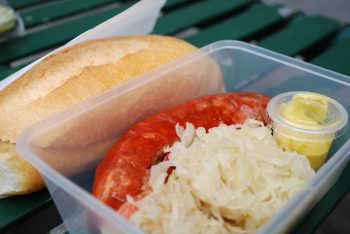
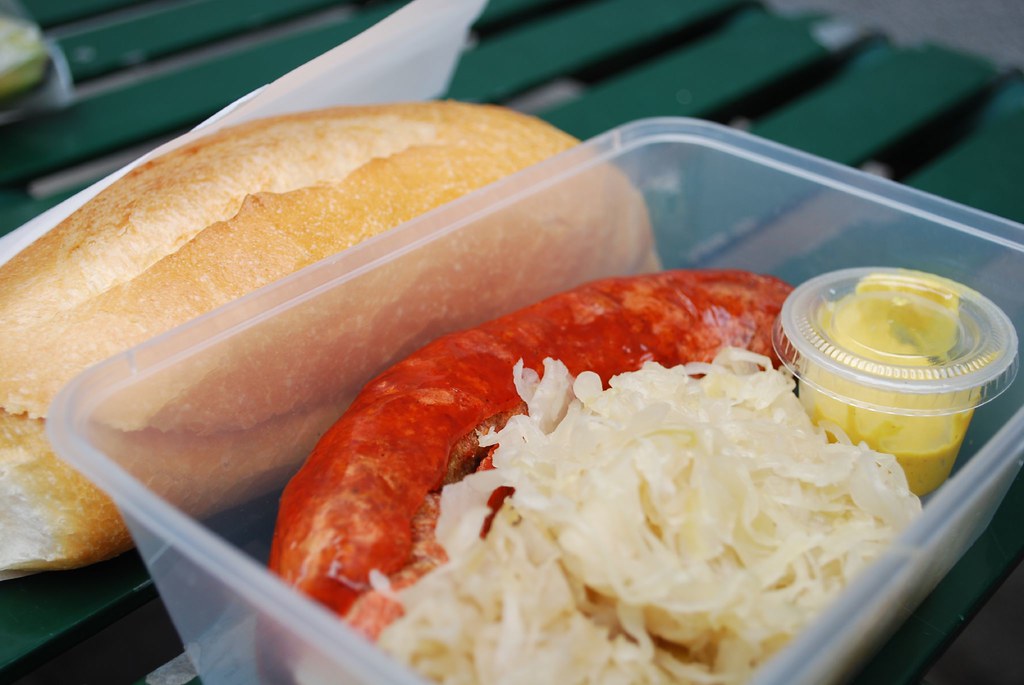
Featured photo: Takeaway box – Mild Bratwurst with Sauerkraut – The Bratwurst Shop AUD5.60 by avlxyz, BY-SA 2.0.